
Fourth Sunday of Advent, December 21, 2025
Judah's King Ahaz was planning a dangerous foreign intrigue when the prophet Isaiah tries to dissuade him with a sign from God. Ahaz, in false piety, demurs, but Isaiah declares the sign anyway.
In these opening verses of his letter to the Romans, Paul first establishes his authority, then briefly lays out his vision of God's eternal plan now revealed in Christ. Believers, including even former pagans, will enjoy resurrection from the dead.
Matthew's gospel begins with several stories of how, even to bring about the birth of Jesus, God had to overcome cultural obstacles and human misunderstanding.
The Historical Situation: In the late eighth century B.C.E., God's people in the promised land had become divided into a northern kingdom, Israel, and a southern kingdom, Judah. Assyria was the dominant power in the region. Israel and another liege state, Syria, were planning to rebel against Assyria. Their kings pressured Judah's king Ahaz to join them. When he refused, they began to plot to overthrow him. Ahaz decided to appeal to Assyria for help against Israel and Syria.
Enter the prophet Isaiah. He is confident that God will protect Judah and king Ahaz, who is, after all, a descendant of David. Isaiah also knows that only mischief can come from getting cozy with the Assyrians. He tells Ahaz to be have faith and not ally himself with Assyria. But Ahaz won't hear of it; he's going ahead with his alliance. Isaiah tells him the Lord wants him to ask Isaiah for a sign of the truth of what he's saying. Ahaz doesn't want to be dissuaded from his plan, so he piously demurs, "I will not ask." In frustration, Isaiah announces a sign anyway, the birth of a son, whose very name reminds everyone that God is with these people.
(Web users can refer to the commentaries in the links below for more on some finer points broached here, like who are the mother and son (Ahaz' wife and his successor, most certainly), how the birth of a child could persuade the king of anything, how the Greek translation of the Hebrew makes the woman of the prophecy into a virgin.)
Your Proclamation: In proclaiming the dialog between the prophet and the king, make Isaiah sound exasperated, as if you were pleading, "Come on, Ahaz, I can prove it to you. Give me a chance, you numb-skull!" Pause. Then make the king sound like the hypocrite he is. What Ahaz says amounts to: "Oh, no, Isaiah. We pious people never ask God for signs." Then pause again, take a deep breath like Isaiah did, play your trump card and pronounce the prophecy, building the dramatic tension until the last word that means "God is with us," Immanuel.
The Historical Setting: The church in Rome did not know Paul personally, so he is at pains to introduce himself and establish his authority. In the first sentence he describes himself as "set apart to proclaim the gospel ...," and later, "favored with apostleship." The rest of the introduction is a summary of the gospel and of the divine plan Paul serves.
Only two phrases of this passage seem "seasonal," the reference to promises made through the prophets, and the reference to Jesus' descent "from David according to the flesh." Those helped some Jews see Jesus as the Messiah, although Jesus fulfilled only a few of their other Messianic expectations.
Paul is more interested in recasting people's expectations of what God might do in human history. The Apostle insists that God's newly revealed agenda goes beyond giving the Jews a new David. It's about resurrection from the dead and bringing the Gentiles (pagans!) to obedient faith now. That is a very big deal, indeed.
The Lector's Proclamation: Proclaim this, then, with the gravity it deserves. The sentences are long, but you can break them sensibly into phrases. Don't rush. Be sure to announce it as "The beginning of the Letter of Paul to the Romans," rather than another "reading from ..."
You might try to imagine what the historically first reading of this letter was like. The Christian congregation in Rome was small, not yet persecuted, meeting in someone's home. These were first-generation converts; their heritage: some Jewish, some Gentile. The religion was still genuinely new to them. They did not celebrate Christmas. They had not divided into Catholics and Protestants. There was no church-sponsored sports program. They knew the reputation of Paul, former persecutor turned apostle, and the word has gone out that he has written them a letter. The church assembles one Sunday, and you have the letter. You stand to read it.
A bit melodramatic, yes. But every time a lector stands to read in a twenty-first century assembly, there's a chance that someone there will hear the words as if for the first time.
The Saint Louis Review, weekly newspaper of the Roman Catholic Archdiocese of Saint Louis (Missouri, U.S.A.), published the Sunday scripture commentaries of scholar and teacher the Reverend Francis X. Cleary, S.J., for a few years, and archived them online even after replacing him with a less intellectually rigorous writer. More recently, the archived Cleary columns have proven impossible to find. This could be due to later editorial disdain for Cleary's exegesis, or embarrassment that Cleary was, several years post-mortem, accused of sexual misconduct. Hypertext links that once fetched his columns now return the bland Saint Louis Review page of the Archdiocesan website.
Francis X. Cleary, S.J., died in December, 2010. The resolutely secular daily, the Saint Louis Post-Dispatch, published an appreciatiion of him. Click here to read it if you subscribe to the print or electronic versions of that paper.
Or, you don't subscribe to that paper, click here to read a saved copy of the article in .pdf form.
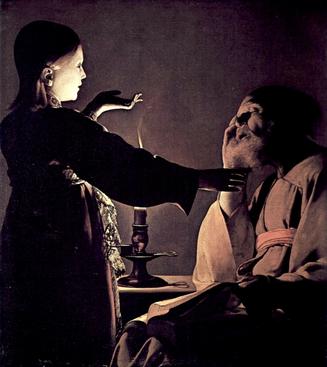
Georges de la Tour, French, 1993-1652, The Dream of St. Joseph, c. 1628-1645, Musée des Beaux-Arts de Nantes, Franch. Click here for a larger version.
This page updated November 18, 2025