
Lector's Notes try to serve the Church by helping lectors prepare to proclaim the Scriptures in our Sunday assemblies. For each day's first and second readings (and occasionally for the gospel), the Notes give the historical and theological background, plus suggestions on oral interpretation.
More … I say below that a lector ought to be prepared, earnest and competent. A new website complements this one by offering professional training in public speaking and the formation of a more responsible parish community of lectors.
Visit YourLectorCoach.com.
 Another very accomplished champion of the lector ministry is George Miller, author of Catholic Lector from the Inside-Out and The Uncommon Lector. On June 26, 2024, George announced that the press of other commitments caused him to take down his websites. His books are still available.
 I have been careful to keep Lector's Notes objective, historical and free of advocacy (except for a few sections clearly labeled "Homily Starter"). In another forum, though, I advocate strongly for church leaders to read and hear the Word of God as addressed not to individuals but to their communities as communities. Click here to read any of my last 20 broadsides linking a Sunday's scriptures to questions of community leaderhsip. You can subscribe from any of them.
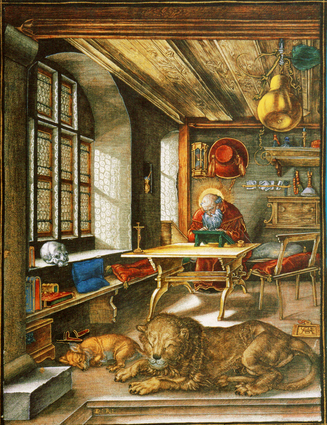
The image is Albrecht Dürer's Saint Jerome in His Study, 1514. It came from a cover of the members' magazine of the Saint Louis Art Museum, from early 2003. It's the only version in color I've seen anywhere. Here's a link to the whole picture on the whole cover (3.1 MB, 1256 x 1536 pixels) This version was very pleasingly color-corrected by Ernest Miller.
I learned as a child that Jerome (347-420) translated the Bible into Latin, the language of ordinary people (at least then and in the West). As an adult, I have yet to research that claim, but I still take Jerome as a kind of patron of Lector's Notes. The Notes try to make the work of scripture scholars available (understandable and terse) to the church members who demonstrate their love of the scriptures most visibly.
Lector's Notes should be easily readable on any device, including small-screen ones like cell phones and tablets. Tech gurus use the term "responsive formatting" for web pages that automatically configure their elements to the user's device. I got it about half right in the first year of making Lector's Notes responsive. Then, in June, 2016, Google showed me a simple change that let me finish the renovation. Every page published thereafter will be responsive. How do they work for you? Your comments are welcome.
Most people in a Sunday assembly hear the word of God only in that formal setting. Their only regular exposure to Scripture is from the lips of the lector and the preacher there. That lays a heavy responsibility on the lector; these notes aim to help you fulfill that responsibility. And if the Notes help a lector sound prepared, earnest and competent, they'll help the congregation decide to take the Scripture's lessons more seriously.
The author, grateful beneficiary of a seminary theological education, also writes the Notes in order to deepen his own understanding and love of the Scriptures, and in hope of sharing that appreciation with an audience already interested in the Scriptures. The author assumes every lector will want to know what he or she is talking about, just as one would for a presentation at work, or in a college seminar. The background of a Lectionary passage is often complicated, so these Notes are challenging, but they're always clear.
Gregory Warnusz creates Lector's Notes, with support from his wife Peg, the former Margaret A. Sampson. Peg and Greg live in northeast Saint Louis County, Missouri, USA, where they are active members of Holy Name of Jesus Catholic Church.
Born in 1947 and able to do the math, Greg is carefully recruiting a succession team for Lector's Notes.
Send Greg a message A little more about the author
This page published late Sunday, April 26, 2026
Last edited on miranda-ubu as index_20260427.html (Filename includes a Monday!)